Sometimes It Isn’t Just Menopause
Why cortisol, overlooked imbalances, and lack of support may be making your symptoms worse.

When your body feels like it’s under constant pressure. . .
There is a point for many women when something begins to feel off.
You don’t quite recognize yourself.
You feel anxious, exhausted, irritable.
You’re not sleeping.Your body is changing in ways you don’t understand.
You’re doing your best to keep up with work, responsibilities, and daily life—but it feels harder than it should.
So you try to fix it.
You diet harder.
You exercise more.
You push through.
And somehow… you feel worse.
If this sounds familiar, please hear this:
You are not failing. And you do not have to sit at home and suffer through this.
When Everything Starts to Shift
Menopause is not just a hormonal transition.
It often arrives at a time when stress has been building for years. Sleep becomes more fragile. Recovery becomes slower. And the body becomes less tolerant of constant pressure.
At the center of this is your stress response—particularly cortisol.
When cortisol stays elevated over time, it doesn’t just affect how you feel day to day. It can begin to affect how your body functions more broadly.
You may notice:
poor or broken sleep
anxiety or a constant “on edge” feeling
weight gain, especially around the midsection
fatigue that doesn’t improve with rest
brain fog
irritability or emotional swings
feeling wired, but exhausted
Sometimes it isn’t just menopause.
Sometimes your body is overwhelmed—and it’s trying to tell you.
When Sleep Starts to Break Down
For many women, one of the first signs that something is off is sleep.
You wake up in the middle of the night—sometimes overheated, sometimes anxious, sometimes for no clear reason at all.
You’re wide awake.
You can’t fall back asleep.
And by morning, you’re already exhausted.
That lack of rest doesn’t stay contained to the night.
It spills into everything:
your mood
your energy
your cravings
your patience
your ability to cope
And when sleep is consistently disrupted, it can push cortisol even higher—creating a cycle that’s hard to break.
When It Goes Unaddressed
This is the part many women aren’t told.
When these patterns continue over time without support, they can begin to affect more than just how you feel.
They can impact:
blood sugar and insulin balance
weight and metabolic health
sleep quality and recovery
cardiovascular health
bone health
how quickly you feel like you’re aging
This isn’t about fear.
It’s about awareness.
Because many women assume they just have to “get through it,” when in reality, their body may be asking for help.
A Gentle Place to Start
If this feels familiar, you’re not imagining it — and you’re not failing.
Sometimes the nervous system simply needs support, consistency, and space to reset.
That’s one of the reasons I created the 7-Day Cortisol Calm — a guided reset designed to help you slow the overwhelm, reconnect with your body, and begin creating small, supportive shifts that feel sustainable in real life.
Instead of extreme routines or rigid wellness rules, the guide focuses on gentle daily practices, nervous system support, reflection, and realistic habits that work with your body instead of against it.
Start With a Small Preview
If you’d like to explore the approach more gently, I’ve also created a small preview from the 7-Day Cortisol Calm guide.
Inside you’ll find gentle practices, reflection prompts, and a small glimpse into the supportive approach used throughout the full guide.
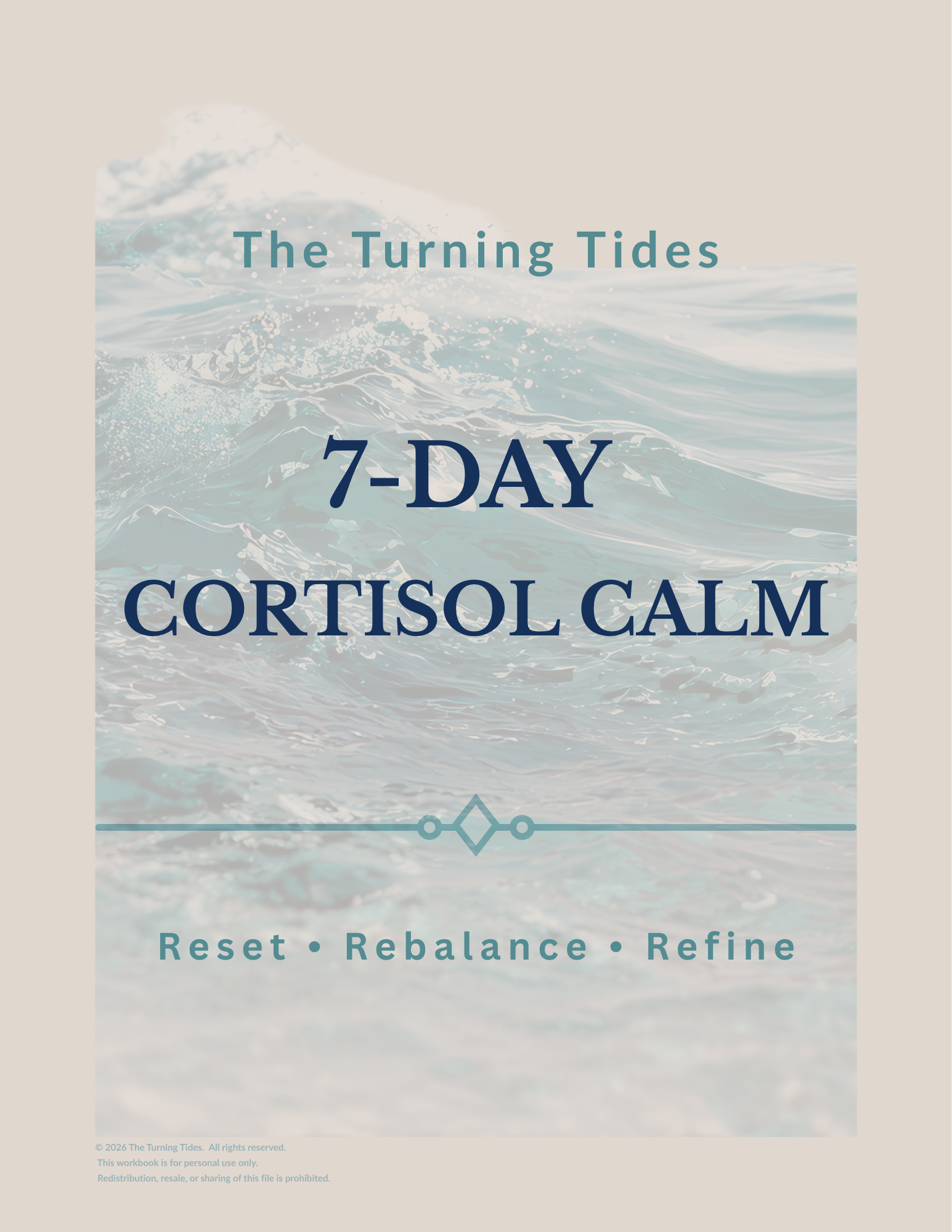
If your mind feels overloaded and your body feels stuck in survival mode, this gentle 7-day reset was created to help you slow down, rebalance, and reconnect with yourself.
[Download the Preview]
Why Pushing Harder Often Backfires
When things feel off, the instinct is to try harder.
Eat less.
Exercise more.
Keep going no matter how you feel.
But when your body is already under stress, this approach can work against you.
Instead of improving symptoms, it can increase cortisol, disrupt sleep further, and leave you feeling more depleted.
This is where many women get stuck—doing everything “right” and still feeling worse.
What May Be Adding to the Load
Yes, habits are not always easy to change—especially when you’re already not feeling your best.
But sometimes, going through a difficult season can also become a quiet turning point.
If your body is already under stress, this may be a meaningful time to begin looking at the habits that could be adding to that load—whether that’s smoking, alcohol, highly processed foods, or excess caffeine.
Not all at once. Not perfectly.
But gradually.
Because even small shifts can begin to support your body in a noticeable way.
And over time, those small changes can become something more—a steady return to balance, strength, and a way of living that better supports you in this next chapter.
You Deserve More Than Guesswork
If your symptoms are affecting your daily life, it may be time to stop guessing—and start investigating.
Not everything you’re feeling should automatically be dismissed as “just part of aging.”
There may be underlying factors that can be addressed.
What to Ask About at Your Appointment
Going in with a clear direction can change the entire conversation.
You may not need every test on this list—but knowing what to ask about can help you have a more productive conversation.
Foundational Health
CBC (Complete Blood Count)
Comprehensive Metabolic Panel (CMP)
Iron panel
Ferritin
Vitamin B12
Folate
Vitamin D
Thyroid Function
TSH
Free T4
Free T3
Thyroid antibodies (if indicated)
Blood Sugar & Metabolic Health
Fasting glucose
Hemoglobin A1C
Fasting insulin (if appropriate)
Hormonal Context
Estradiol
Progesterone
FSH / LH
Testosterone (if indicated)
DHEA-S (in some cases)
Stress / Cortisol
Morning cortisol (if your provider feels it’s appropriate)
Advocate for the Care You Deserve
You do not need to become your own doctor.
But you do deserve to become an informed, engaged patient.
If something doesn’t feel right:
ask questions
request evaluation
explain your symptoms clearly
seek support
And if you don’t feel heard, it is reasonable to find a healthcare provider who takes your concerns seriously—especially someone experienced in hormone health or midlife wellness.
You Don’t Have to Stay Stuck Here
You do not need to spend every day feeling lost, forcing yourself through worsening symptoms, and wondering what happened to you.
There may be answers.
There may be support.
There may be a path forward.
Sometimes the next chapter begins the moment you stop blaming yourself—and start investigating what your body needs.
A Way Forward
If you take anything from this, let it be this:
You’ve been heard.
You’re not imagining what you’re feeling.
And you don’t have to navigate this alone.
There are tools available to you:
understanding what may be happening in your body
knowing what to ask for
seeking the right support
making small, meaningful shifts over time
You don’t have to fix everything at once.
But you can take the next step.
And sometimes, that step is simply deciding that you deserve to feel better—and beginning to advocate for yourself in a way you may not have before.
Continue the Reset
If you’ve been feeling exhausted, wired, emotionally overwhelmed, or disconnected from yourself lately, you’re not alone.
And while there’s no instant fix, small intentional shifts can make a meaningful difference over time.
That’s why I created the 7-Day Cortisol Calm — a guided reset experience designed for women navigating stress, overwhelm, hormonal shifts, and mental fatigue.
Inside the guide you’ll find:
Gentle daily nervous system support
Simple cortisol-conscious lifestyle practices
Reflection and reset prompts
Mindset and emotional grounding exercises
Supportive wellness tools that feel realistic and achievable
What’s Included
Day 1 — Awareness & Understanding
Day 2 — Slow the System
Day 3 — Nourish, Not Restrict
Day 4 — Move Gently
Day 5 — Boundaries & Input
Day 6 — Rest & Sleep Reset
Day 7 — Reset & Rebalance
Inside you’ll find gentle practices, reflection prompts, and a small glimpse into the supportive approach used throughout the full guide.
(Available as a printable digital guide for personal use.)
